Scaling & Growth
Why One Book Isn't a Strategy, But a System Is
October 7, 2026 · 1,811 words
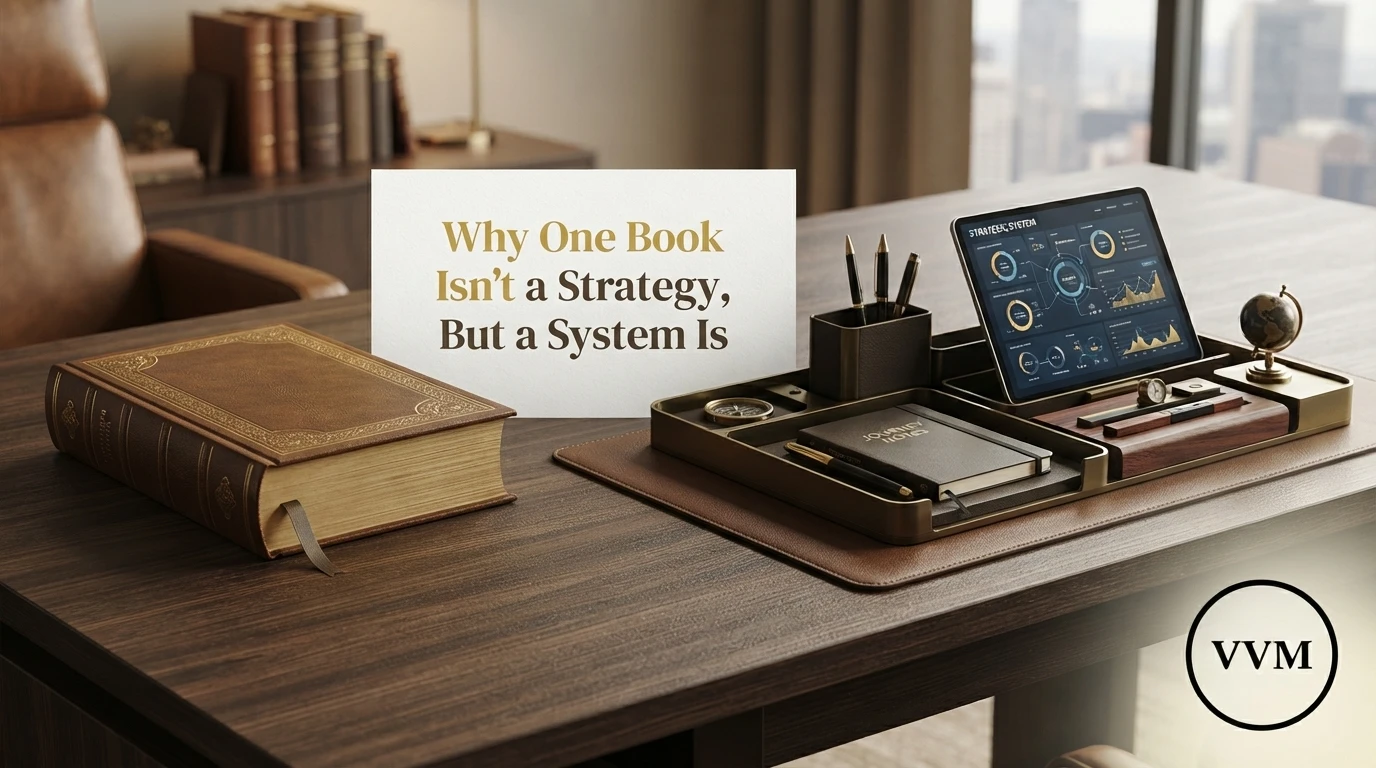
Quick Summary: A book alone is just a product, but a system turns that book into a scalable engine for lead generation and business growth. By connecting your manuscript to a website, clear offers, and content loops, you ensure your expertise keeps working long after the initial launch buzz fades. Valor & Ventures Media Publishing specializes in building these integrated systems to help authors transform their writing into a sustainable, revenue-generating legacy.
You have a book in you. But a manuscript alone won't scale your business, because most authors treat it as the destination. Growth leaders treat it as the first brick in a larger structure of strategic systems. Write the book, launch it, and watch the buzz fade within weeks. That happens when there's no system to capture, nurture, and convert new readers.
This guide shows why a book by itself fails as a business strategy, and how building business systems around it turns your expertise into scalable business systems that work while you sleep. Think growth systems, not one-time launches. Think legacy building strategy, not a vanity project. Your entrepreneurial strategy for strategic planning 2026 starts here, pairing operational efficiency with proven business success models.
Table of Contents
- The Illusion of the One-Time Launch
- The Architecture of a Scalable Growth System
- Operational Efficiency Through Content Loops
- Building a Legacy That Lasts
- Which Should You Choose: The Standalone Book or the Integrated System?
- Frequently Asked Questions
- Conclusion
Single Book vs. Growth System: Key Differences
| Single Book Approach | Book-Centered System | |
|---|---|---|
| Primary Goal | Initial brand exposure | Lead generation and authority |
| Audience Engagement | Transient, one-way | Continuous, two-way |
| Operational Impact | Minimal change | Full process integration |
| Scalability | Limited to print sales | Unlimited via digital funnels |
| Business Longevity | High risk of plateau | Sustainable growth model |
How Single Book Approach and Book-Centered System Compare
Single Book Approach
Here, the book is the finish line: write it, publish it, and hope sales carry the brand. It works for initial exposure and shelf credibility, but engagement stays one-way and growth plateaus once the launch buzz fades. As a business strategy, it leaves you rebuilding from scratch with every new title.
Key strengths
- Fast path to published authority
- Clear, simple goal: get the book out
- Low operational lift
Book-Centered System
This approach treats the book as the front door to strategic systems: a website, launch content, a coaching offer, and repeat content that feed each other. It suits founders and consultants who want lead generation, not just sales, and it turns building business systems into a repeatable engine. Engagement becomes continuous and two-way, so the book keeps working long after launch day.
Key strengths
- Sustainable, scalable growth through digital funnels
- Ongoing audience engagement
- Full integration with your offers
The Illusion of the One-Time Launch
You spend eighteen months writing the book. You throw a launch party, push hard for two weeks, then watch the sales graph flatten into silence. The book did not fail. The plan did. A launch is an event, and events end. A business strategy keeps working after the confetti settles.
Watch: [Avoid This Book Launch Strategy Mistake at All Costs](https://www.youtube.com/watch?v=LbQTWPKoauc)
Why Visibility Does Not Equal Authority
Being seen and being trusted are different things. A spike of press coverage puts your name in front of readers for a moment, but attention fades unless something holds it. Authority comes from repetition: the same message, the same offer, showing up week after week.
That is the difference between a one-time push and building business systems. Strategic systems turn your book from a product into a front door. Readers finish a chapter, land on your website, join your list, and book a call with a coach who actually helps them. Nothing about that depends on launch week.
Key tip: If your only plan is the launch, you have no plan. You have a deadline.
Compare the two paths:
| One-Time Launch | Repeatable System |
|---|---|
| Sales stop when the buzz stops | Leads arrive daily |
| One message, one moment | Content compounds over time |
| Hope-driven | Data-driven |
The Architecture of a Scalable Growth System
A book becomes a business when you connect it to four moving parts: a home base, a launch runway, a paid next step, and content that keeps the flywheel turning.
Converting Readers into Clients
The last page of your book is the start of a decision, not the end of a sale. Every reader who finishes it has just proved something valuable: they trust your thinking. Your job is to give that trust somewhere to go.
Start with a home base. That means a simple website with one clear offer, a way to capture emails, and a page that answers "what do I do next?" A reader who clicks through should land somewhere that matches the book's promise, word for word.
Then build the bridge. Offer a free tool mentioned in the book, like a checklist or worksheet, in exchange for an email. Follow up with a short series that walks readers toward a coaching call, a workshop, or a consulting engagement. A book built this way works as the front door, not the whole building.
Tip: Track one number above all: how many readers book a call. If it is low, the problem is usually a vague next step, not the book.
Repeatable content, such as a podcast or newsletter, keeps new readers arriving long after launch week ends.

Operational Efficiency Through Content Loops
Automating Your Authority
A book is a one-time event. A content loop is a machine. The difference shows up in your calendar: one demands constant effort, the other keeps working after you close the laptop.
A content loop takes one core asset, your book, and breaks it into repeatable pieces. A chapter becomes a LinkedIn series. A framework becomes a podcast outline. A case study becomes an email sequence. You write once, then repurpose with intention.
Set a rule for yourself: every hour of finished book content should yield at least ten pieces of shorter material. Count them. If you fall short, the loop is leaking.
The payoff is time. Authors who manually chase visibility burn weekends on posts that vanish in a day. Authors with a system schedule a month of content in an afternoon, because the structure already exists. One angle in, many assets out.

This is the Systemic Author mindset at work. Your authority compounds without your constant presence, so your energy goes to clients, not to feeding the algorithm.
Ask us to build your loop with you. Valor & Ventures Media Publishing maps the repurposing plan before your book ever ships.
Building a Legacy That Lasts
A book can mark a moment. A system builds a legacy. The authors who shape industries for decades don't just write once and hope the book carries them. They build repeatable ways to reach the next reader, the next client, and the next stage of their own thinking.
Think about what lasts. A book goes on a shelf. A system keeps working. Your website answers questions while you sleep. Your coaching offer turns readers into clients. Your content calendar keeps your ideas in front of people long after launch week ends. That's the difference between a trophy and a tool.
The good news: none of this requires more writing. It requires packaging what you already wrote so each chapter does double duty. One chapter becomes a workshop. Another becomes a blog series. A third becomes the backbone of a consulting offer.

Legacy isn't built in one launch. It's built by giving your book a job, then a second one, then a third.
Which Should You Choose: The Standalone Book or the Integrated System?
Ask yourself one question: what do you want the book to do?
If the answer is "leave a record of my service or share my story with family," a standalone book is fine. Write it, publish it, put a copy on the shelf. Done.
But if you want the book to grow a business, attract clients, or build lasting influence, a standalone copy will almost always underperform. It sits there. A system works for you.
Here's the difference:
| Factor | Standalone Book | Integrated System |
|---|---|---|
| Primary goal | Legacy or record | Business growth |
| Launch | One-time event | Ongoing content engine |
| Sales | Single transaction | Book leads to coaching, speaking, retainer work |
| Effort over time | Front-loaded, then stops | Builds compounding momentum |
The honest trade-off: a system takes more setup. You'll build a simple website, plan launch content, and shape a clear offer behind the book. But that setup is what turns one-time readers into long-term clients.
If you're unsure where your book fits in a broader growth ecosystem, start with the outcome you want, then build backward from it.
Your book deserves a system behind it. Valor & Ventures Media Publishing helps you build the launch plan, content engine, and coaching offer that turn one book into lasting income. Let's turn your dreams into a reality at /publishing/start.
Frequently Asked Questions
Q1: Why is a system more effective than a single book for scaling a business?
A book builds trust once; a system converts it repeatedly through offers, content, and follow-up.
Q2: How can a book function as the foundation of a broader business strategy?
It becomes your proof, your pitch, and your product gateway.
Q3: How do you turn business insights from a book into repeatable operational systems?
Package each chapter's method into a service, template, or coaching offer.
Q4: What are the key elements of a growth system that supports author-led businesses?
Website, launch content, a clear offer, and repeatable content.
Q5: Why does one-off content fail to create long-term business authority?
Authority needs consistent, visible proof over time.
Q6: How should leaders bridge the gap between thought leadership and operational execution?
Turn ideas into documented steps others can run.
Q7: How can digital platforms amplify the impact of business books for entrepreneurs?
They extend reach through articles, podcasts, and community features.
Q8: What role does community play in scaling a brand beyond a single book launch?
Community sustains referrals, feedback, and momentum long after launch day.
Let's turn your dreams into a reality. Start your publishing journey at Valor & Ventures Media Publishing.
Conclusion
A book builds authority. A system builds income. The difference is what happens after launch day: a website that captures readers, launch content that warms them up, a coaching offer that turns attention into revenue, and repeat content that keeps the whole loop running. Authors who treat the book as the gateway, not the finish line, create something that works without constant effort. Those who stop at publication usually watch the momentum fade. If your expertise deserves more than a spine on a shelf, it deserves a repeatable model around it. That is the Systemic Author approach, and it is within reach for any serious first-time author. Let's turn your dreams into a reality.