Creating a Brand
What Makes a Book "Authority-Building" Instead of Just Published
October 7, 2026 · 1,184 words
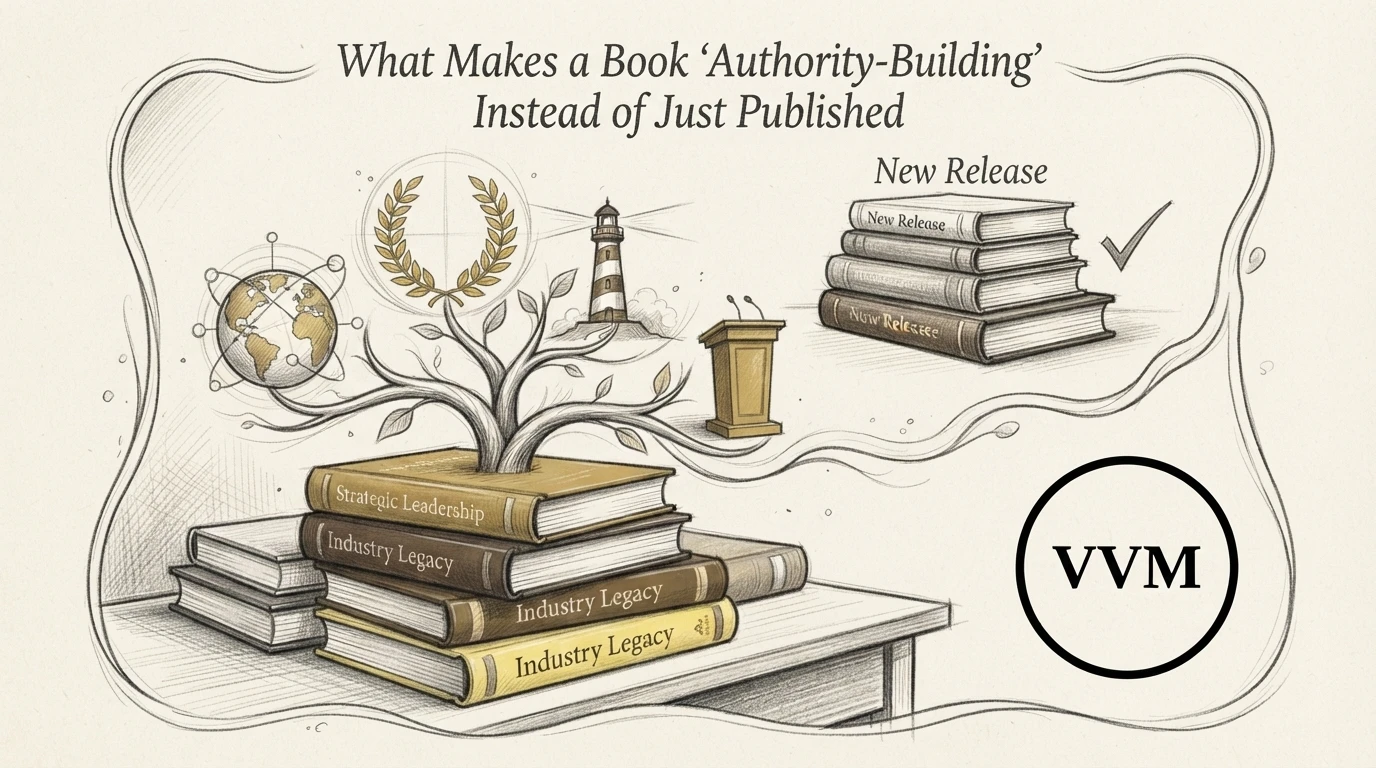
Quick Summary: An authority-building book functions as a business asset rather than a simple publication by prioritizing strategic positioning and actionable frameworks. By focusing on specific audience needs and proprietary methods, authors can convert readers into clients and long-term professional opportunities. Valor & Ventures Media Publishing supports this process by helping founders codify their unique expertise into lasting legacy projects.
Anyone can hit publish. An authority book earns its keep after launch. Many professionals write thought leadership books that gather dust because they chase word count, not results. An expert positioning book works differently: it ties your knowledge to clear business goals. To write authority book projects that last, you need a real book content strategy, smart author branding tips, and professional book marketing. This publishing authority guide covers the markers we found in legacy building books that grow influence, plus the business book strategy behind them.
Table of Contents
- Authority Building Elements at a Glance
- What to know about building authority through your book
- Strategic Positioning
- Curated Storytelling
- Actionable Frameworks
- Targeted Audience Alignment
- Additional Pillars of Credibility
- How to choose the right strategy for your book
- Frequently Asked Questions
Authority Building Elements at a Glance
| Core Element | Primary Benefit | Target Impact | Authority Metric |
|---|---|---|---|
| Strategic Positioning | Clarity | Industry Leadership | Conversion Rate |
| Curated Storytelling | Connection | Audience Trust | Retention Rate |
| Actionable Frameworks | Utility | Implementation | Application Frequency |
| Targeted Audience Alignment | Relevance | Lead Generation | Qualified Outreach |
What to know about building authority through your book
An authority book is not a memoir and not a simple guide. It is a business asset that proves what you can do and shows your point of view. Written well, it turns readers into clients, partners, and peers.
That is why thought leadership books matter right now. Decision-makers search for proof before they trust anyone. A clear expert positioning book gives them that proof on page one.
The difference comes down to strategy, not word count. Here is what separates the two.
1. Strategic Positioning
The foundation of your authority is knowing exactly what you stand for. Before you write a word, define the problem you solve and for whom. Many thought leadership books fail here: without clear positioning, they inform but never convert into board seats, clients, or keynote invitations.
An expert positioning book works like a beacon. Many event planners refuse to book speakers without one, because it proves your message fast.
Highlights
- Defining your unique market niche
- Aligning book goals with business KPIs
- Crafting a clear expert identity
Pros
- Increases perceived value
- Attracts the right clients
Cons
- Requires significant upfront planning
It ranks first because strategy, not writing, turns a book into a business tool.
Last updated: October 7, 2026
2. Curated Storytelling
Humanize your technical skills through the power of narrative. As a veteran or leader, you have experiences others cannot replicate. Curated storytelling bridges the gap between raw data and human experience, so readers trust your perspective instead of skimming past it.

Highlights
- Links personal experience to industry lessons, choosing stories that validate your expertise without overshadowing the reader's journey
- Facts stick better in narrative form; research suggests facts are far more likely to be remembered when part of a story
Pros
- Builds deep rapport
- Memorable content that lifts retention
Cons
- Difficult to balance vulnerability and professionalism
Readers connect with stories far more effectively than abstract theories, making this essential for genuine influence.
Last updated: October 7, 2026
3. Actionable Frameworks
An authority book does not just tell readers you are smart. It hands them tools they can use. Codify your internal processes into repeatable frameworks, and readers get immediate value while you prove you are a practitioner, not a theorist. Utility like this is what makes thought leadership content trustworthy to decision-makers, per LinkedIn's research with Edelman.

Highlights
- Codifies your proprietary methods into named intellectual property
- Gives readers tangible ROI they can apply the same week
- Sets your book apart from competitors who offer opinions only
Pros
- Highly shareable and easy to cite
- Differentiates you in a crowded field
Cons
- Requires honest, deep analysis of your own work
Frameworks keep your book on the desk, not the shelf, so your name stays relevant long after launch. For a working example, see how MDMP in Business turns a military planning process into a repeatable business method.
Last updated: October 7, 2026
4. Targeted Audience Alignment
Speak directly to the people who matter most to your future. Generic books appeal to everyone and resonate with no one, but precise books turn readers into clients. The Nonfiction Authors Association shows authors who serve a niche stand out and sell more.

Highlights
- Identifying high-impact niches
- Tailoring tone and technical depth
- Solving specific audience problems
Pros
- Higher conversion potential
- Clearer market positioning
Cons
- Limits initial reader base
It ranks here because reaching 100 of the right people beats reaching 10,000 of the wrong ones.
Last updated: October 7, 2026
Additional Pillars of Credibility
These four elements round out your strategy, but they shine only when built on a clear purpose. Treat them as supporting pillars, not the foundation itself.
- Professional Editing - Polishing your message to meet high professional standards.
- Brand-Integrated Distribution - Getting your book into the right hands in your sector.
- Legacy Focus - Crafting content that stays relevant for years.
- Community Integration - Engaging your network to extend your authority's reach.
How to choose the right strategy for your book
Start with the outcome. More speaking invitations, a fuller consulting pipeline, or a formal legacy each point to a different approach.
- Define your business goal before you write a word.
- Assess your capacity: can you draft it, or do you need ghostwriting and editorial support?
- Name your audience and their current challenge.
- Codify your methodology so the book feels proprietary.
- Choose long-term utility over a one-time splash.
For veterans and military-connected founders, Valor & Ventures Media Publishing pairs ghostwriting with legacy strategy, so authority compounds for years.
You've earned real experience. Now turn it into a book that builds lasting authority. Start your book build with Valor & Ventures Media Publishing and publish with purpose.
Frequently Asked Questions
Q1: How does writing a book build professional authority differently than just getting published?
Authority comes from proof and positioning, not printing.
Q2: What are the key elements that turn a standard business book into an authority-building asset?
Original frameworks, client proof, clear takeaways.
Q3: How can authors align their book content with a broader brand strategy to foster influence?
Match book themes to services and speaking.
Q4: How can veteran and entrepreneur authors use their books to shape industry narratives?
Challenge norms with tested field lessons.
Q5: Why is strategic storytelling essential for building legacy through a book?
Stories create trust and memory.
Q6: What common mistakes prevent a published book from effectively establishing expert authority?
Vague advice, no proof, weak promotion.
Q7: What role does a resilient community play in amplifying the impact of an author's message?
Communities share, discuss, and spread ideas.
Q8: How should business leaders measure the ROI of an authority-building book?
Track leads, speaking invitations, and rates.